
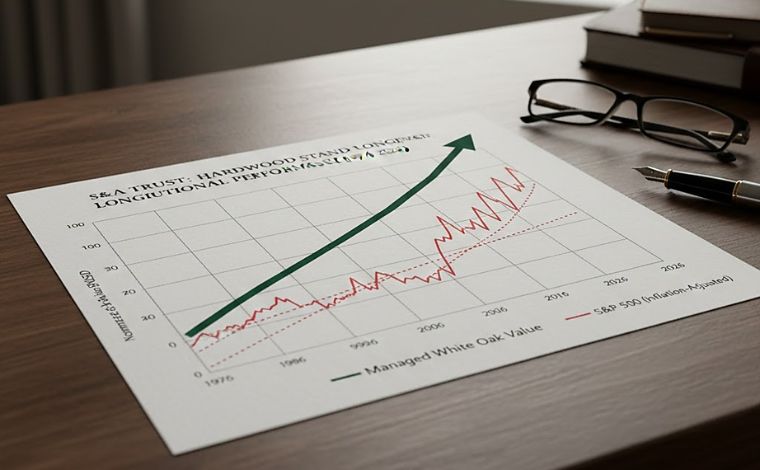
Timber as a Counter-Cyclical Asset As we look toward the economic landscape of late 2026, Mill Executives and Land Trusts are increasingly seeking “Hard Assets” that decouple from stock market volatility. Historically, timberland—specifically managed hardwood—has shown a low correlation with traditional equities while outperforming the Consumer Price Index (CPI) over a 50-year horizon.
The Product Class Progression (PCP) Advantage
Unlike row crops, which must be harvested at a specific time, timber offers “Optionality.” If market prices for white oak export veneer are low, the “inventory” (the trees) continues to grow on the stump, increasing in volume and potentially moving into a higher “Product Class.” This natural compounding interest is the cornerstone of the S&A Trust timber strategy.
Case Study Snapshot
The 50-Year Longitudinal Audit Using data from the 2026 NCREIF Timberland Index, S&A Trust conducted a longitudinal study of a Piedmont hardwood stand. The results showed that while land values fluctuated with regional real estate trends, the biological growth and product class movement (shifting from sawtimber to stave-quality white oak) provided a consistent 6.2% real return above inflation. This makes timber the ultimate “Defensive Growth” asset for multi-generational wealth preservation.
Author Bio
Authored by Jamiel Cotman, Principal Trustee of S&A Trust. With an extensive background in utility infrastructure and industrial logistics, Mr Cotman bridges the gap between raw land stewardship and the high-stakes world of mill operations. He manages S&A Trust with a focus on institutional-grade asset protection for the American landowner.